If the nerves in your feet are starved of blood, no amount of medication will fix the underlying problem. That is the simple reason compression therapy keeps showing up at the top of successful neuropathy plans.
Dr. William Greenlee
Neuropathy & Nerve Pain Specialist
Ask most people what causes neuropathy and they'll say diabetes. Ask what treats it and they'll list medications. Both answers are incomplete. Between the nerve itself and the brain that interprets its signals, there is a whole chain of dependencies — and blood supply sits near the top of that chain.
Peripheral nerves are famously demanding. They are long, they are metabolically active, and they are entirely dependent on a steady, reliable flow of oxygenated blood. When that flow slows — from diabetes, vascular disease, inactivity, or simply the biology of aging — the nerves at the far end of the line suffer first. That's why neuropathy almost always starts in the feet and toes.
This is the reason leg compression therapy earns such a prominent spot in our treatment plans. It addresses the supply line directly. Not a side effect, not a workaround — the actual thing the nerves are missing.
Neuropathy is usually described purely as a nerve condition. In practice it is almost always a nerve condition and a circulation condition, running together and feeding each other. Damaged nerves don't regulate blood vessels well. Poorly perfused tissue doesn't repair nerves well. The two problems lock together and quietly get worse.
This matters for treatment because it explains why some patients plateau. If you only work on nerve signaling and never address perfusion, you're fixing half the equation. Our article on daily habits that support healthy circulation covers what you can do at home. Compression therapy is what we can do in the clinic, at a level that's hard to replicate on your own.
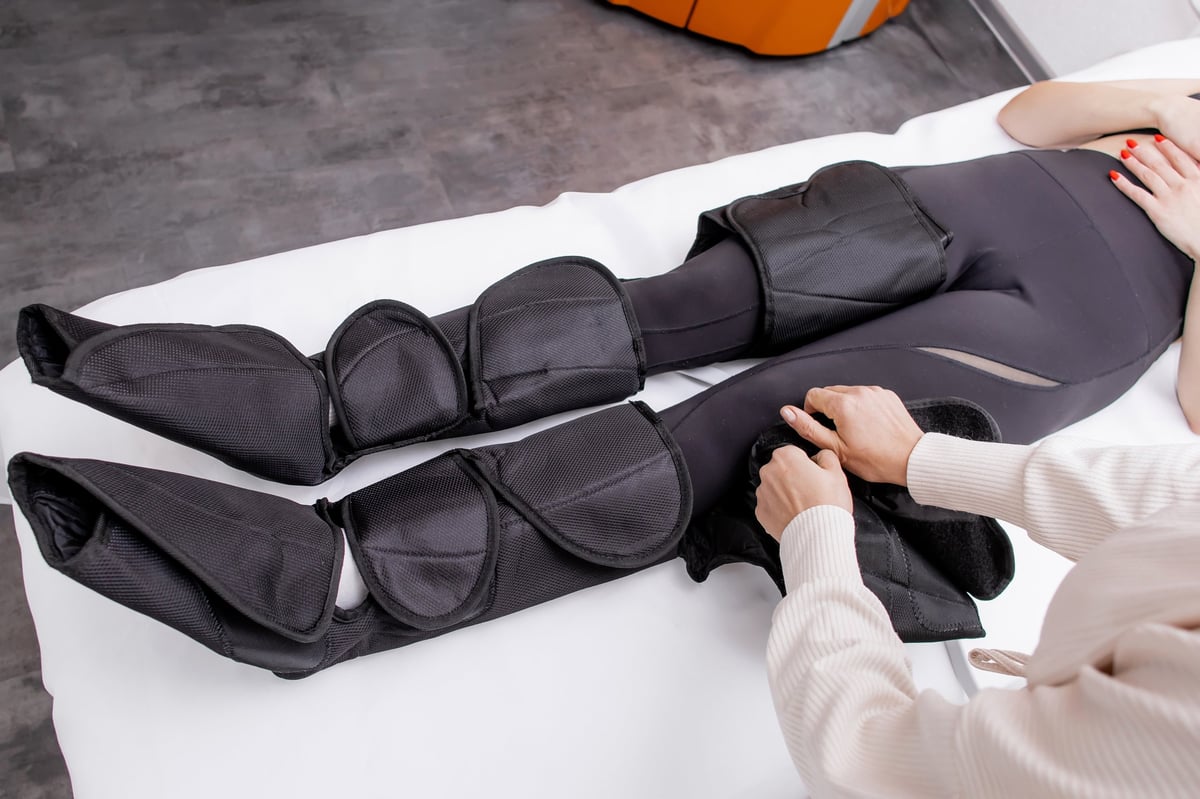
If you've ever had a blood pressure cuff inflated around your arm, you already understand the basic principle. Compression therapy uses inflatable sleeves wrapped around the legs that fill with air in a programmed sequence, squeezing and releasing in a rhythm designed to assist your circulation.
The important word there is sequence. This isn't a uniform squeeze. The chambers inflate from the bottom upward — calf, then lower leg, then thigh — creating a wave of pressure that pushes fluid in the direction blood is supposed to travel. It works with your body's own venous system rather than fighting it.
Blood that has delivered its oxygen needs to get back up the leg. That return trip relies on muscle contractions and one-way valves — both of which weaken with age and inactivity. Compression sleeves do the work those mechanisms used to do.
Swelling in the ankles and lower legs is common with neuropathy, and it puts extra pressure on already-irritated tissue. Sequential compression helps clear that fluid rather than letting it pool.
The squeeze-and-release cycle creates a mild pressure differential that encourages fresh, oxygen-rich blood to flow back into the extremity. More supply means better conditions for nerve tissue to function and repair.
Many patients describe their legs as feeling "full" or "loggy" by the end of the day. That sensation is largely fluid and pressure. Compression reliably lightens it, often immediately.
You can read the full clinical overview on our leg compression therapy page.
Circulation support is the headline, but compression therapy earns its reputation across several fronts at once. Here's what it does that matters specifically for nerve pain patients.
Nerve cells need oxygen and glucose to run their repair processes. Improving perfusion gives them the raw materials they've been lacking.
Reducing fluid pressure and swelling in the tissue around the nerves often softens the intensity of burning, aching, and pins-and-needles sensations.
Lighter, less swollen legs translate to better movement — and better movement supports circulation. It's a genuinely virtuous cycle.
Neuropathy symptoms spike at night when circulation naturally slows and there are no distractions. Patients frequently report sleeping better after regular sessions.
Better blood flow supports skin integrity and healing. For feet that are numb and prone to unnoticed cuts, that protection is genuinely important.
No pills, no needles, no interactions with existing prescriptions. For patients already managing a medication list, that matters more than it sounds.
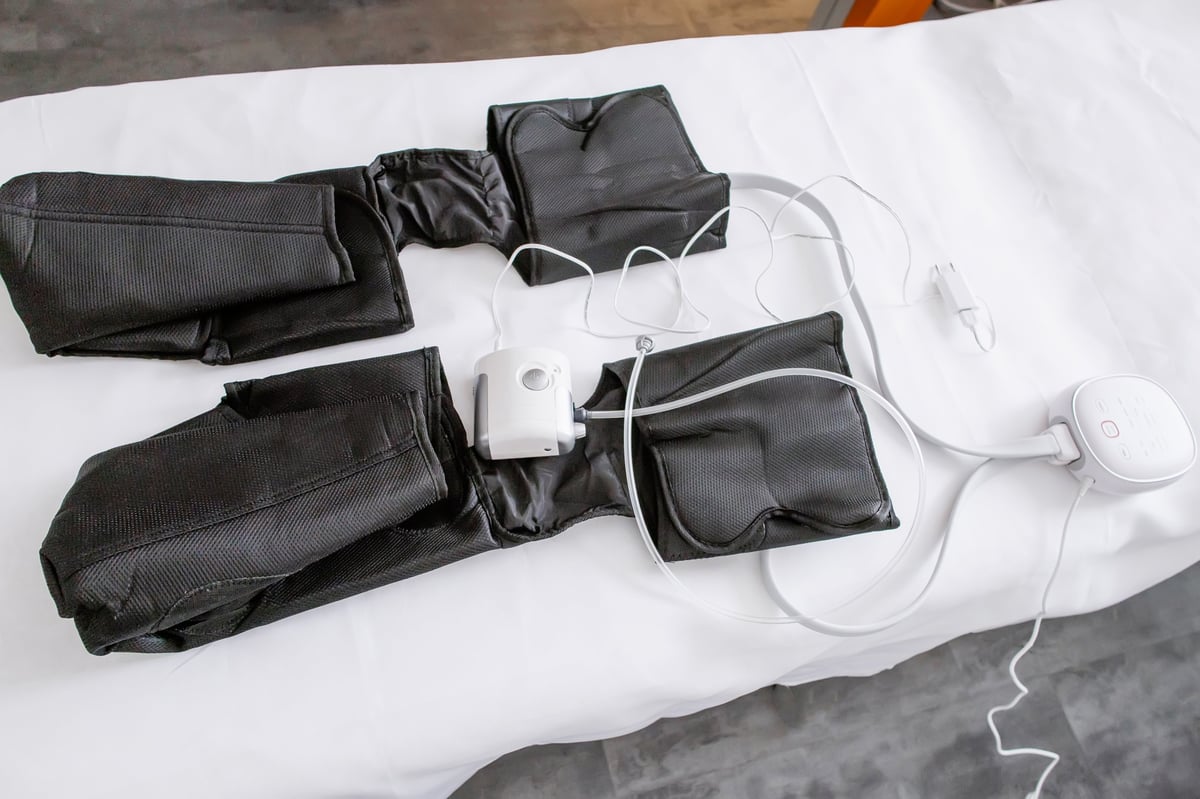
It's one of the least demanding treatments we offer. If you've been put off by the idea of therapy being painful or exhausting, this is the opposite end of the spectrum.
Compression therapy is broadly well-tolerated, but some patients respond more dramatically than others. We see the strongest results in people dealing with diabetic and peripheral neuropathy who also have visible swelling, heaviness, or cold feet. Those signs suggest circulation is a meaningful part of the picture, which means there's more for compression to actually do.
On the other hand, if your symptoms trace primarily to a pinched nerve root in the spine, compression alone won't be enough. That's exactly why we examine first — the evaluation process for peripheral neuropathy is designed to separate vascular contributors from spinal and metabolic ones.
No single therapy solves neuropathy, and any clinic claiming otherwise is overselling. Compression works best as the circulation backbone of a combination approach. In our clinic it's frequently paired with red light therapy to support cellular repair, and electric stimulation to calm overactive nerve signaling.
When spinal compression is also present, spinal decompression addresses the pinched nerve root so compression therapy isn't fighting against an upstream problem. And vibration plate therapy can layer in low-impact muscle activation, which reinforces circulation without stressing painful joints.
The sequencing matters. A good plan targets the specific mix of problems your exam revealed, rather than running every patient through an identical menu.
Here's the honest version. Many patients notice a difference in how their legs feel within a session or two — lighter, less tight, less heavy by evening. That early relief is real, but it's partly fluid-related and partly transient.
The changes that last come from repetition. Consistent sessions over weeks help establish better baseline circulation, and that's when patients start reporting that burning is less severe, that they're walking further, or that they're waking up fewer times at night.
It's also worth saying plainly: compression therapy is not a cure. Nerves repair slowly, and some damage may not fully reverse. What it reliably does is remove obstacles — improve the conditions under which your body can do its own healing. That's not a lesser goal. It's often the difference between a slow decline and genuine improvement.
We are a nerve pain clinic in Southlake, Texas. Not a spa, not a general practice with a compression machine in the corner — a clinic built specifically around neuropathy and nerve pain. That focus changes what we notice, what we measure, and how we sequence treatment.
Care is led by Dr. William Greenlee and built around three principles. First, find what's actually driving the symptoms rather than treating a label. Second, combine therapies instead of depending on any single device. Third, track progress honestly and adjust the plan when something isn't earning its place.
You can explore our full approach on the neuropathy treatment in Southlake, TX page, or learn more about our doctor and evaluation process.
A focused evaluation at our Southlake clinic shows us how much of your symptoms trace back to circulation — and whether compression, or something else, should lead your treatment.
771 Southlake Blvd., Suite 123 · Southlake, TX · Mon–Thu 8AM–6PM
Related pages and articles to help you go deeper.
Full details on the treatment, benefits, and what to expect.
How light therapy relieves nerve pain at the cellular level.
Simple daily routines that keep blood flowing to the extremities.
Symptoms, causes, diagnosis, and treatment in Southlake, TX.
Gentle electrical signals that calm pain and wake up quiet nerves.
Our full range of drug-free options for nerve pain in Southlake.